Find Eczema-Friendly ProductsFind a Doctor
Logo
search
menu
About Eczema
Research
News & Stories
Get Involved
About Us
Donate
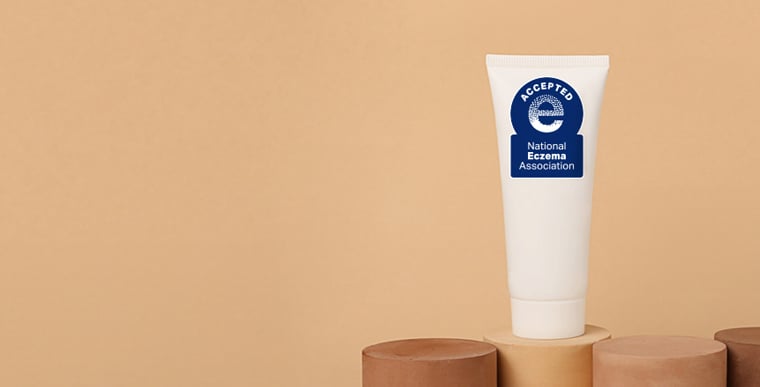
Product bottle with NEA seal of acceptance

About the Seal of Acceptance™

Meet the new standard for your skin. The Seal empowers you to find products that are suitable for your life with eczema and sensitive skin.

On this page

  • Understanding the Seal
  • Ecz-clusion List
  • Guidelines for the Seal
  • How Products Get the Seal

Back to top

up arrow

Understanding the Seal

Eczema is a chronic condition without a known cure (yet), which means at-home management with suitable products is key. For the millions of people who live with eczema — and even more with sensitive skin — the search for personal care and household products can be triggering, in every sense of the word.

With the Seal of Acceptance™, we’ve done the vetting for you. You might recognize that little blue symbol — the Seal — on some of your favorite personal care and/or household products, but what exactly does it mean? What makes a product qualified to receive the Seal?

Since 2008 the Seal has been the most trusted mark in eczema products. The Seal empowers you to find products that are suitable for you and your family. When you see the Seal, you can be sure the product is free from ingredients on the Ecz-clusion List — a list of known eczema triggers — and has undergone rigorous testing and scientific review.

For a product to obtain the Seal, it must meet the strict ingredient and clinical safety testing standards established by our Scientific Oversight Committee and pass review of ingredients, formulation and testing data by members of an independent panel of leading dermatologists, allergists and eczema experts.

Our Seal experts keep up with the latest research so that you don’t have to.

Our goal is not only to help you find eczema-friendly products, it’s also to drive brands/manufacturers to do better, creating products that are free of known allergens and irritants. Keep in mind that eczema is different for everyone and a product that works for one may not work for another, or even for the same person over time.

Find personal care and household products with the Seal in the Seal Product Directory — and check back regularly for new additions.


Ecz-clusion List

For a product to obtain the Seal, it cannot contain any of the ingredients on the Ecz-clusion List in any amount. The Ecz-clusion List is a list of known allergens and irritants commonly found in skincare and household products. Because these ingredients are known irritants and allergens for people with eczema and sensitive skin, NEA does not allow them in products that receive the Seal. The Ecz-clusion List may evolve over time and be periodically updated in response to new data and innovation.

Ingredients on the Ecz-clusion List

These ingredients are not allowed in products that receive the Seal:

  • Alpha-amyl cinnamic alcohol (Amylcinnamaldehyde)
  • Bacitracin
  • Benzocaine
  • Cinnamic alcohol
  • Cinnamic aldehyde
  • Citrus aurantifolia (lime) peel powder
  • Citrus aurantium dulcis (orange) peel oil
  • Citrus extract
  • Citrus limon (lemon) peel powder
  • Citral
  • Citronellol
  • Coumarin
  • Eugenol
  • Farnesol
  • Formaldehyde
  • Geraniol
  • Hexyl cinnamic aldehyde
  • Hydroxycitronellal
  • Isoeugenol
  • Lidocaine
  • Lyral (Hydroxy-isohexyl cyclohexene carboxaldehyde)
  • Methylchloroisothiazolinone
  • Methyl dibromo glutaronitrile
  • Methylisothiazolinone
  • Myroxylon balsamum / (Balsam of Talu)
  • Myroxylon pereirae resin / (Balsam of Peru)
  • Neomycin sulfate
  • Oak Moss Absolute
  • Polymyxin B sulfate
  • Propolis
  • Shellac
  • Triclosan

In addition to the Ecz-clusion List ingredients, products cannot include:

  • Fragrance — Products must be fragrance-free, and there should be no discernable/strong scent or anything aromatic in nature in the final product.
  • Chemical UV absorbers (only physical sunscreen products containing titanium, zinc and iron will be considered)
  • Formaldehyde releasers

Guidelines for the Seal

Who created the scientific guidelines for the Seal?

The Ecz-lusion List and other Seal guidelines were set by NEA’s Seal Scientific Oversight Committee. This is a panel of leading dermatologists, allergists and eczema experts selected by NEA.

In addition to setting the ingredient guidelines, the committee established the criteria and framework for the overall Seal review process based on the most current scientific information.

The criteria and strict review process states:

  • Products cannot contain any ingredients on the Ecz-clusion List.
  • All products must be fragrance-free with no scent present in the formula. U.S. labeling laws require a company to note on the label if there is a fragrance. Additionally, there should be no discernable/strong scent or anything aromatic in the final product.
  • Products must undergo and pass acceptable clinical safety testing requirements.
  • Products must be included on the eligible list of products for the Seal.

What products are eligible for the Seal?

Products must fall into one of the following product categories to be considered for the Seal:

  • Personal care products
    • Moisturizers
    • Cleansers (excluding exfoliating products and scrubs)
    • Hair products
    • Disposable wipes
    • Deodorant/Anti-perspirant
    • Lip care, which includes: (if the lip product does not fit the below type then the product will be considered on a case-by-case basis.)
      • Lip balm
      • Lip salve
      • Lip oil
      • Lip gel
      • Lip butter
  • Sunscreen
  • Over-the-counter (OTC) drugs
  • Laundry products
  • Household cleaning products

In order to obtain the Seal, brands/manufacturers must provide documentation that a product has undergone and passed the required clinical safety tests for sensitivity, irritation and toxicity.

What clinical testing is required from brands/manufacturers?

In order to obtain the Seal, brands/manufacturers must provide documentation that a product has undergone and passed the required clinical safety tests for sensitivity, irritation and toxicity.

Testing requirements for Seal:

NEA requires at least one of the following tests be completed and submitted by the brand/manufacturer for each product formula:

  • Human Repeat Insult Patch Test (HRIPT)
  • Cumulative Irritation Test (CIT)
  • Safety In Use (SIU)

If the clinical safety test does not meet Seal requirements, the product is not eligible to apply for the Seal. 

Testing guidelines:
  • All testing data must have the Fitzpatrick Skin Type or a similar report submitted with the testing data that shows different skin types, varying gender and age stratification from 18 years old and up.
  • It is acceptable for the testing site to be outside of the United States as long as the requirements are met.
  • Product testing on animals is not accepted.
  • Toners can apply, but only a “Safety in Use” test will be accepted for the review of a toner.
  • NEA does not endorse or have a relationship with any clinical safety testing company.

Download a PDF of the Seal’s clinical testing requirements

Who reviews product applications for the Seal? 

The Seal Review Panel is the ultimate decision maker in whether or not a product is accepted to receive the Seal. The Seal Review Panel is made up of doctors that are selected by NEA for their expertise in dermatology, specifically eczema and sensitive skin care, and they hold MD, PhD and DO credentials. They must adhere to the strict guidelines set by the Seal Scientific Oversight Committee when reviewing applications and products.


How Products Get the Seal

1. Product or brands/manufacturers apply for the Seal

Product or brands/manufactures must fill out an application form for each product they wish to have evaluated. Each application includes:

  • A full account of all active and inactive ingredients, concentration levels, and function in the formula of each product.
  • Clinical testing reports for the product.
  • Product samples.

Only products that have applied for and pass the review process are awarded the Seal. NEA does not solicit brands/manufacturers to apply for the Seal.

2. NEA reviews product ingredients

Evaluation of a product’s formulation is a big part of the Seal review process. NEA has identified ingredients in its Ecz-clusion list that are known irritants and allergens that cannot be included in a product that applies for the Seal.

3. NEA reviews clinical testing reports

To be considered for the Seal, brands/manufacturers must have completed clinical testing for each individual product. Clinical testing is a way in which brands/manufacturers make sure their products are suitable. NEA accepts various types of clinical tests. Brands/manufacturers are solely responsible for identifying and working with outside companies to obtain this testing.

4. NEA reviews product samples

NEA receives product samples from the brands/manufacturers to ensure there is no fragrance or anything aromatic in nature present and to allow for reviewers to use the product as intended.

5. Seal Review Panel reviews all materials

The product samples, along with the clinical testing reports, are sent to a panel of doctors who are part of the Seal Review Panel selected by NEA. The Seal Review Panel is the ultimate decision-maker in whether or not a product is accepted to receive the Seal. Applications are accepted or rejected.

6. Accepted products are notified

When a product is awarded the Seal, NEA enters into a license agreement with the brand/manufacturer allowing them to utilize the Seal logo on accepted products in the U.S. and Canadian markets.

7. Brands/manufacturers reapply for Seal annually

Product or brands/manufacturers are allowed to renew their Seal license annually. However, to ensure a product still meets our high standards, a brand/manufacturer must:

  • Provide an up-to-date ingredient list
  • Sign an attestation indicating there have been no changes to the formula since they first applied
  • Report if there have been any adverse reactions on a particular product/ingredient submitted to the FDA

If there is a change in formula, even a minor one, the brand/manufacturer must restart the application process with new clinical testing.

Apply for the Seal

Toggle drawer

Get the latest in eczema news, delivered.

Sign up for NEA's e-newsletter to receive evidence-based articles, expert-sourced lifestyle tips and stories from your community.

Nea footer logo
  • About NEA
  • Press Room
  • Contact Us
  • Careers
  • Seal of Acceptance Application
  • Partnership Opportunities
  • Privacy Policy
  • Terms and Conditions
facebookXyoutubesocial iconthreadslinked-in

The National Eczema Association (NEA) improves the health and quality of life for people affected by eczema, and empowers those who advocate, support and deliver care.

Our Accreditations

National Health Council standards of excellence certification programGuide Star Seal of TransparencyBetter Business Bureau accredited charityGlobal Skin internation alliance of dermatology patient organizationsaccreditation logo

NEA is a qualified 501(c)(3) EIN 93-0988840.

© National Eczema Association, All rights reserved 2026