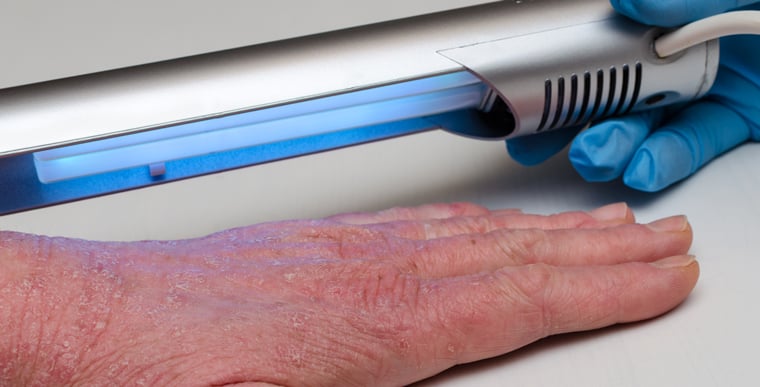
Who administers phototherapy treatment?
Your dermatologist prescribes phototherapy. However, not all dermatologists have phototherapy machines in their offices. If they do not have it in their medical office, they will refer you to another location that offers the treatment. Your dermatologist will set the treatment plan based on your unique needs, which is what the other office will follow.
Phototherapy sessions can be administered by a dermatologist. They can also be done by a nurse or medical assistant who is following the treatment plan set by the dermatologist.
Sometimes, you can even get a phototherapy machine in your home, but this depends on insurance approval.
What can you expect during a phototherapy treatment?
The phototherapy machine is typically a full-body booth. The procedure can vary slightly depending on the type of phototherapy machine.
For treatment, you’ll be asked to undress so the areas to be treated are exposed to receive direct light. The healthcare provider may ask you to keep sensitive areas covered like goggles to protect eyes or underwear to cover the genital area. You will step into the phototherapy booth and the door will be closed. The provider starts the machine and the machine’s lamps will emit light according to the dosage determined by your doctor. The light-emitting machine will be activated for a short time, usually a few minutes. When the lights turn off, the provider will open the door so you can leave the booth.
If you are undergoing PUVA phototherapy, you will be given an oral medication or apply a medicated cream to the skin before the phototherapy treatment.
Before each new treatment session, your provider will ask about your reaction and any side effects from the previous session.
How often do you have to go for phototherapy?
Eczema is unique in every person, so phototherapy is as well. The course of treatment is different for everyone, depending on the type of eczema and its severity. Treatments are individually prescribed according to the patient’s skin type, tendency to burn, current medications, amount of pigmentation in skin, the response of their eczema and whether they have had skin cancer in the past. Additionally, providers consider what medications you are taking to decide on treatment protocol. For example, certain antibiotics and hypertensive medications may cause a stronger response to phototherapy.
Generally, people start with a low dose treatment about three times per week. It may take one or two months of regular treatments before an improvement in symptoms is seen. Depending on results, that dose can be increased over time. If phototherapy is working well after a few months, your provider may reduce the number of sessions per week.
A trial period for phototherapy is usually three to six months. If you hit six months and aren’t seeing any results, your doctor will typically want to move on to a different treatment option.