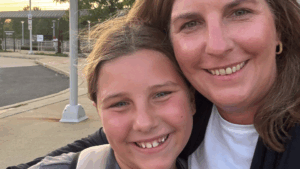
This Duo’s Superpower? Friendship and Resilience Only a Mom and…
Amy and Ella’s mother–daughter eczema story highlights resilience, friendship and community support, offering encouragement for families facing eczema.


Published On: Oct 17, 2025
Last Updated On: Nov 19, 2025
When Bryan was a toddler, his mom noticed rashes on different parts of his body. Since then, Bryan’s experience with eczema has evolved — from experiencing frustrating flare-ups that impacted his ability to play trumpet as a kid, to sleep disruptions in adulthood.
Through it all, Bryan discovered a unique superpower: his ability to track patterns, spot triggers and make sense of it all by analyzing his flares. In conversation with the National Eczema Association (NEA), Bryan shared how science has helped him find community and redefine life with eczema on his own terms.
The interview has been condensed for length and clarity.
NEA: When did you first notice your eczema symptoms?
Bryan: I was diagnosed with eczema as a toddler, after my mom noticed repeated rashes on the inside of my elbows, behind my knees and around my neck.
Over-the-counter (OTC) treatments weren’t working, so my mom took me to a dermatologist and I was prescribed a topical steroid. It initially provided immediate relief, but as I got older, my eczema eventually stopped responding to it.
NEA: How did your diagnosis and symptoms make you feel?
Bryan: I remember starting to play the trumpet in elementary school. I had to use my mouth extensively to play the instrument, and at the time, I had eczema on my face—especially around my lips. It was hard to deal with as a child. Eventually, I stopped playing the trumpet altogether because it became too painful, which felt really frustrating.
NEA: What challenges have you faced as an adult?
Bryan: My eczema went away for a while when I was a teen and young adult, but then it came back during the pandemic. I had to go through a new skincare journey to find my “holy grail” products.
Also, as an adult, I noticed how much my eczema could impact my quality of sleep. Being uncomfortable made it hard to get to sleep at a reasonable hour, and I would wake up in the middle of the night, itchy underneath my sheets.
NEA: Has your eczema ever affected your social or professional life?
Bryan: Professionally, I’m a researcher and a NEA Ambassador. I contribute to several initiatives that aim to better understand eczema.
Socially, I teach Filipino martial arts, where there’s a lot of skin-to-skin contact. During sparring, I have to be mindful of protecting my skin or guarding flares. I try to be conscientious about how I present myself on the mat.
There’s also emotional labor I have to persevere through. While eczema no longer prevents me from engaging in activities I love, I manage my flares so I can be fully present for my students and colleagues.
NEA: What is your “inner superpower” for managing your eczema?
Bryan: My superpower is being quite analytical. As a researcher, I’m trained to interpret data, and it’s been empowering to monitor my eczema flares and treatments over time.
I use NEA’s resources to help track different symptoms like flares, itches and types of rashes. It allows me to zoom in or out to spot patterns and trends.
When I notice a flare, I try to understand what conditions may have contributed to it and reverse engineer what happened. Monitoring my symptoms allows me to be introspective and anticipate or avoid future flares.
NEA: Who are your biggest supporters?
Bryan: The folks at NEA have been some of my biggest supporters in this space. Of course, I also have the support of my family, friends and wife. While they empathize with what I go through, they don’t live with eczema. It’s different to have an organization whose mission is so deeply tied to what I’m experiencing.
NEA connected me to a broader community. I grew up in a rural area and didn’t know anyone else with eczema. Now, I’m part of a network involved in activities like dermatology journal readings, Ambassador huddles and advocacy efforts where we meet with congressional staffers to push for eczema research funding. Attending NEA’s Eczema Expo has been especially valuable.
I’ve also had opportunities to provide patient-centered insights to help guide future eczema research. That’s been exceptionally meaningful.
One day I hope there will be a cure for eczema, but until then, I feel very supported by NEA and the community it creates.
NEA: What advice would you give to someone who’s just been diagnosed or is struggling to manage their symptoms?
Bryan: For someone newly diagnosed, I recommend visiting the NEA website. There are so many resources that are specifically tailored for people with eczema — from articles and magazines to podcasts and community stories.
When my eczema returned in adulthood, I spent a lot of time researching. It helped me find community and also taught me how to break down and understand complex medical terms.
The more you’re able to connect with others who have eczema, the more confident you’ll feel managing your condition. You’re not alone. There’s a growing number of adults diagnosed with eczema every year, and there’s a strong community here to support you.
Anything but typical: Celebrating me with AD
NEA has partnered with Understand AD™, supported by Sanofi and Regeneron, NEA has partnered with Understand AD™, supported by Sanofi and Regeneron, to create an educational campaign that empowers people living with atopic dermatitis, the most common form of eczema, and their caregivers with tools to advocate for their health. This year, Understand AD features Bryan’s and other eczema community members’ unique “superpowers” — the inspiring traits, strategies and mindsets their eczema journey has given them.
The campaign encourages honest conversations about the realities of eczema, celebrates the strength found in community support and underscores the importance of open dialogue with healthcare providers. Visit UnderstandAD.com to discover other stories and video resources from the eczema community.
Amy and Ella’s mother–daughter eczema story highlights resilience, friendship and community support, offering encouragement for families facing eczema.

Since he was an infant, Bryson has been navigating life with atopic dermatitis — the most common form of eczema. What his mom, Lynell, initially thought was cradle cap (a skin condition in infants characterized…

Ar describes how they used a frustrating encounter with a doctor as motivation to shift the narrative and become their own best advocate.

Matt shares how his love of sports connected him with a group of friends who played an important role in in his life, and accepted him, despite his eczema.


Evidence-based articles, expert-sourced lifestyle tips and stories from your community.